

Antivirus vs. EDR: Why Traditional Protection Isn’t Enough Anymore

For years, “having antivirus” meant you were covered.
It was the baseline. Install it, keep it updated, and you were doing your part to stay secure.
But the way attacks happen today has changed, and antivirus hasn’t kept up.
That’s where the gap is.
What Antivirus Actually Does
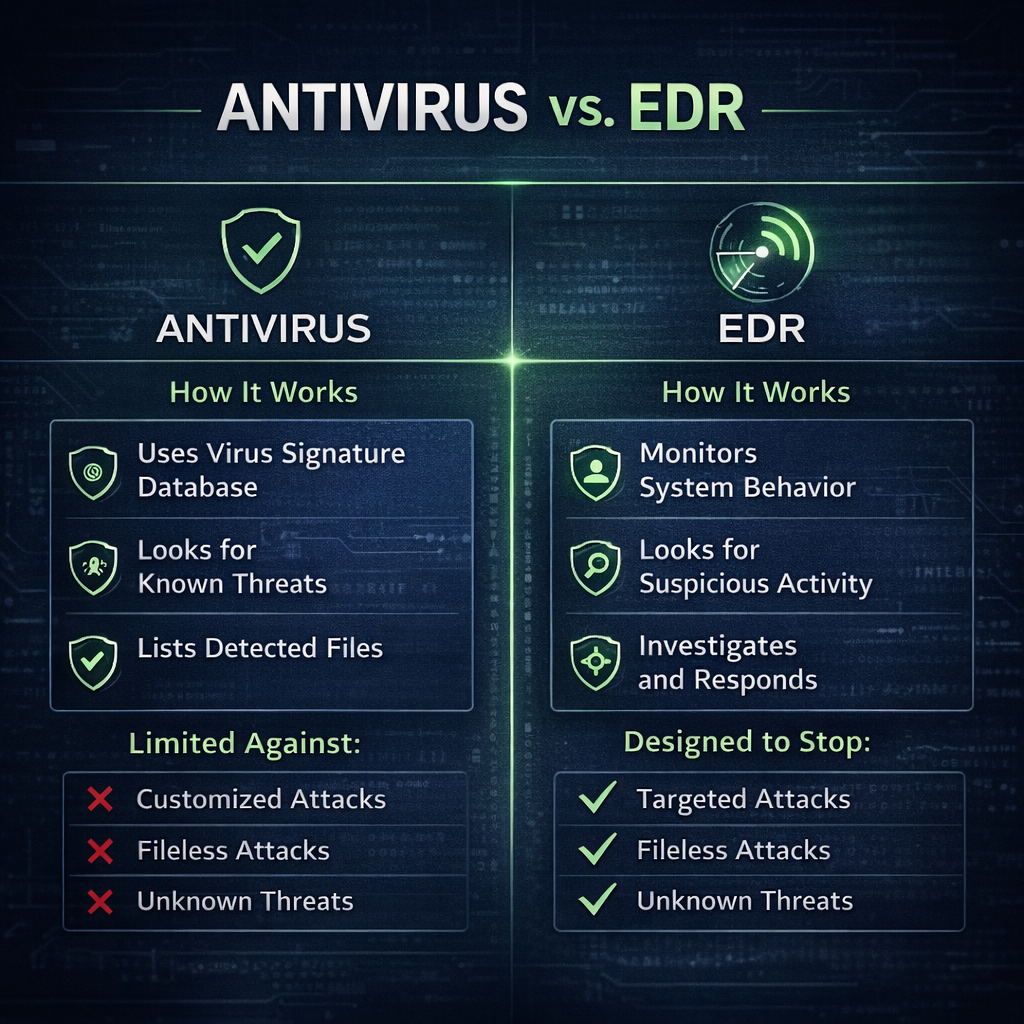
Traditional antivirus is built on a simple idea: Find known threats and block them.
It relies on:
Signature databases (known malware fingerprints)
Basic heuristics (simple pattern recognition)
If a file matches something in its database, it gets flagged.
If it doesn’t… it’s usually allowed.
That worked when most threats were:
Mass-distributed viruses
Reused malware
Predictable attack patterns
That’s not how attacks work anymore.
What’s Changed in Cyber Attacks
Modern threats are:
Customized
Fileless
Delivered through legitimate tools
Designed to avoid detection
Attackers don’t need to drop a “virus” on your system anymore. Instead, they:
Log in using stolen credentials
Run commands through built-in tools
Move quietly across systems
From antivirus’ perspective, nothing looks obviously malicious.
Because technically…it isn’t.
What EDR (Endpoint Detection & Response) Does Differently
EDR (Endpoint Detection & Response) flips the model.
Instead of asking: “Is this file known to be bad?”
It asks: “Is this behavior normal?”
EDR monitors:
User activity
Process behavior
System changes
Lateral movement across devices
And it looks for patterns like:
A user logging in from two locations
PowerShell executing unusual commands
A process accessing files it normally wouldn’t
It’s not just detection, it’s context.
The Key Difference Between Antivirus and EDR
Antivirus is reactive.
EDR is investigative.
Antivirus says: “I’ve seen this before—it’s malicious.”
EDR says: “This doesn’t look right. Let’s stop it and figure out why.”
That difference matters because most real-world attacks today don’t use anything that’s been seen before.
Why Antivirus Alone Falls Short
We still see environments where:
Antivirus is installed
Everything appears “green”
And an incident still happens
Not because antivirus failed, but because it was never designed to catch that type of activity.
It’s like having a lock on the front door while someone walks in with a valid key.
Does That Mean Antivirus Is Useless?
No.
Antivirus still plays a role in:
Blocking known threats
Providing a basic layer of protection
But on its own, it’s no longer a complete cybersecurity strategy.
It’s one piece—not the solution.
What a Modern Approach Looks Like
A well-protected environment typically includes:
Continuous monitoring
Controlled access (MFA, least privilege)
A response plan when something looks off
Not because it’s overkill—but because attacks don’t rely on a single failure point anymore.
A Better Way to Think About Cybersecurity
Instead of asking: “Do we have antivirus?”
The better question is: “Would we know if something unusual was happening right now?”
That’s the gap EDR is designed to close.
Advance Your Cyber Protection
Most businesses didn’t make a wrong decision. They just haven’t revisited it.
Antivirus used to be enough.
It just isn’t anymore.
And the sooner that shift is made, the fewer surprises there are down the road.